


As next-generation electronics demand higher performance, lighter form factors, and mass production, optical materials have become a bigger differentiating factor. In 2025, Pixelligent advanced the nanocrystal-enabled optical materials that are shaping the future of extended reality (XR), display, and sensor technologies.
Pixelligent’s 2025 innovations center on three formulated products, with each addressing challenges across varying product markets. Check out some of the highlights from this year below.
PixMicro™ Is Redefining Optical Sensor Performance
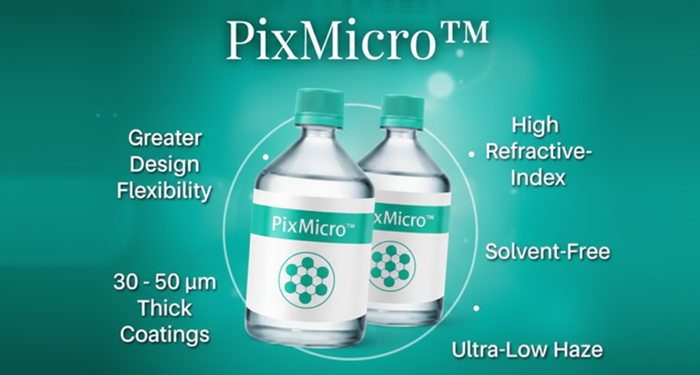
Optical sensors require solvent-free, high-index materials to efficiently capture and direct light. Pixelligent’s PixMicro™ formulations support microptics with flexible sensor geometries, enable wider angles of light capture, and improve processing efficiency.
PixMicro™ also helps to deliver potential cost reductions exceeding 80% versus traditional photolithography-based approaches. These advantages position PixMicro™ as a compelling solution for automotive, industrial, and emerging sensor-driven applications where performance and cost must scale together.
PixNIL® Is Powering the Transition to Lightweight, Transparent XR
XR continues to rapidly expand and place more demand on optical materials. Pixelligent continues to be a leader in optical materials for transparent augmented reality (AR) displays.
This year, Pixelligent expanded their PixNIL® portfolio with formulations optimized for lightweight waveguides, delivering reliable adhesion to plastic substrates without the use of adhesion promoters. Furthermore these products withstand the most stringent environmental reliability tests. With refractive indices of 1.72 or higher, these materials enable lighter AR devices while reducing the need for glass-based components.
PixJet® Expands to Support Advanced Display Architectures
Pixelligent has developed a new PixJet® material for OLED displays that is capable of making microlens arrays through inkjet technology.
These materials improve brightness and efficiency while enabling application-specific light control – particularly valuable for automotive displays, where directional viewing enhances safety and user experience. Additionally, these materials enable longer battery life and brighter screens in applications like tablets.
Nanocrystal Leadership as a Competitive Advantage
Pixelligent’s formulations aren’t the only thing making waves this year. Pixelligent’s award-winning PixClearProcess® production technology has also seen some upgrades. This development and manufacturing platform enables the exceptionally small, highly uniform nanocrystals with narrow particle size distributions, while maintaining a high refractive index.
This capability is essential for optical systems that require low haze, minimal absorption, and high transparency. Pixelligent is also in a unique position to change the surface of the nano materials to make sure that they’re compatible with any resin system the team is working with.
What’s Next for Pixelligent
Beyond the applications previously mentioned, Pixelligent sees growing opportunity for its high-index optical materials in adjacent applications, including photonic integrated circuits (PICs) that enable low-power, high-speed data transfer for AI-driven systems, as well as ophthalmic lenses and accessibility-focused optical technologies where optical precision and reliability are critical.
By leveraging manufacturing processes already embedded within the semiconductor and display ecosystems, Pixelligent’s approach lowers cost barriers and shortens the path from premium, early-stage devices to scalable, mass-market solutions.
Connect with Pixelligent at SPIE 2026
To explore how Pixelligent is advancing optical materials for XR and beyond, visit the Pixelligent booth at SPIE 2026 or attend Pixelligent’s VP of Product Development, Neil Pschirer’s session: Engineering n~2.0 nanomaterials for scalable reliable extended-reality applications.
This presentation will introduce second-generation PixNIL® formulations developed for industrial XR substrates, including high-index plastics and glass. Building on earlier materials with refractive indices of 1.9-2.0 at 589 nm, these next-generation formulations deliver broader process windows, stronger substrate adhesion, and low-defect, high-fidelity replication.
To learn more about Pixelligent’s Designer Compounds®, contact our team today.